Decision Construction clears the path between a rebuild plan and an energized, financeable, buildable property — coordinating LADWP, SCE, SoCalGas, and telecom so Southern California's fire recovery actually moves forward.
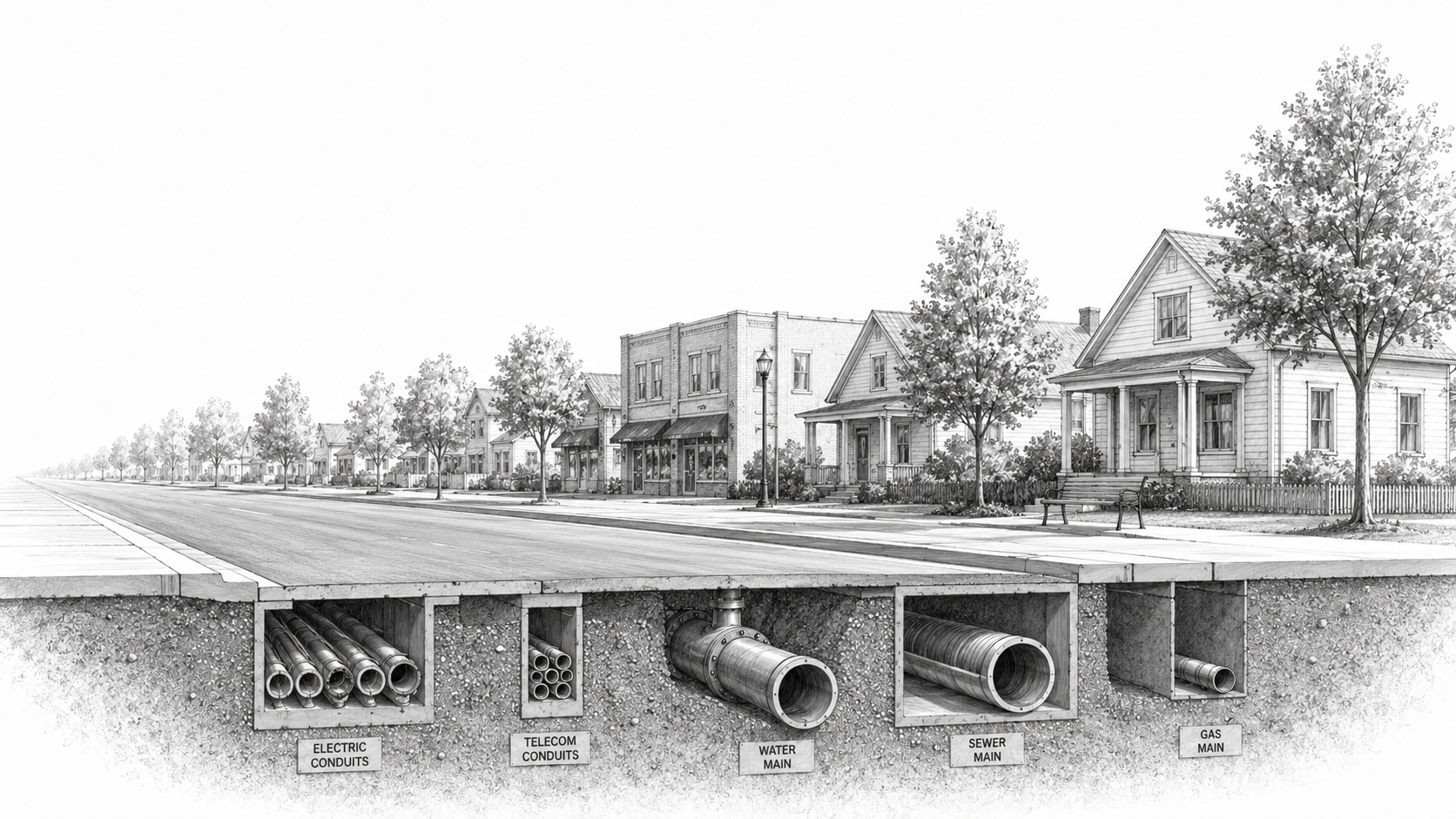
ACT II — The undergrounding · trench · conduit · vault
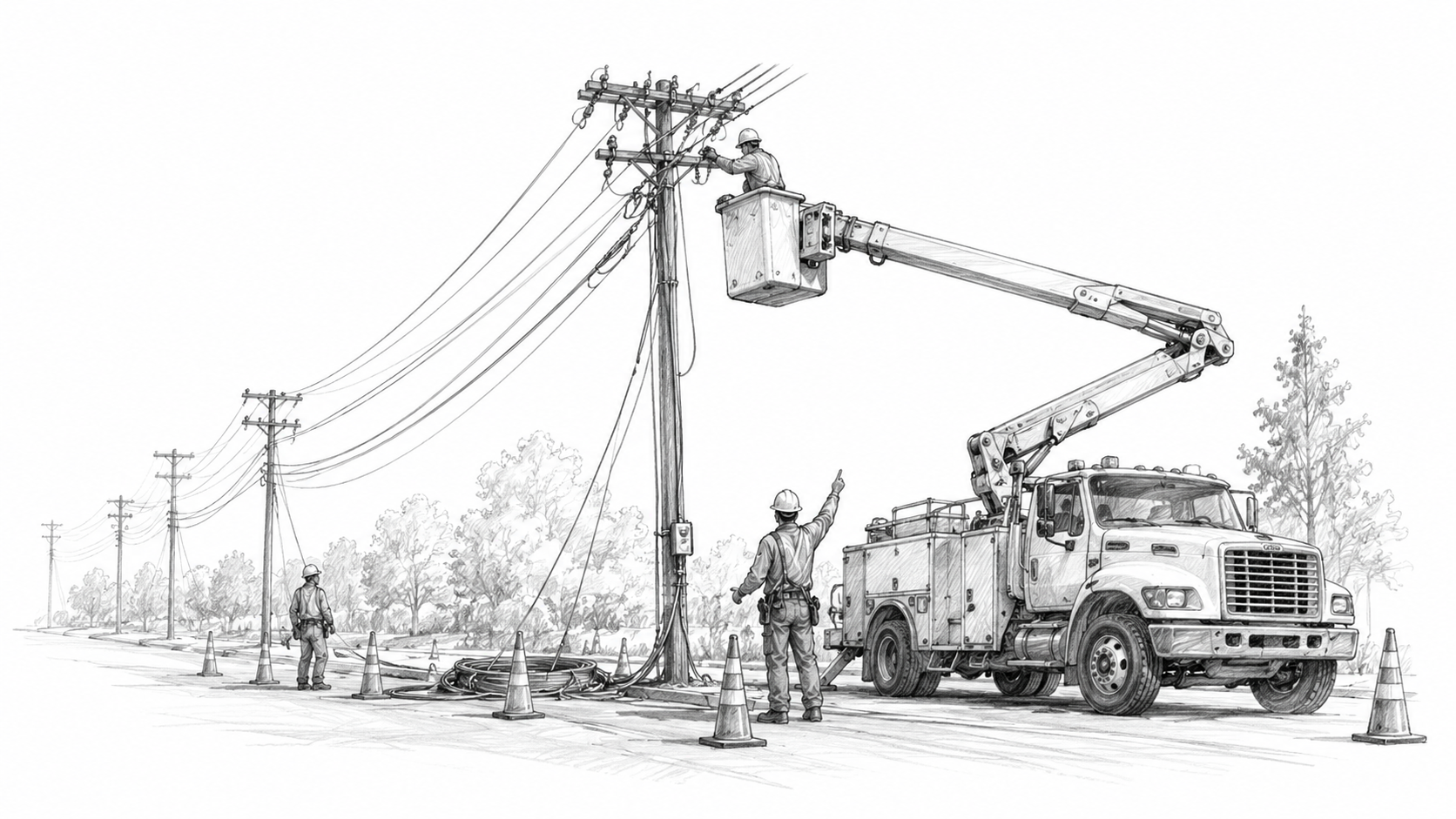
ACT III — Energized from below · nothing overhead but sky
~½of utility consulting for Palisades parcels under construction rebuild†
Firstand only active neighborhood-level undergrounding project in Altadena, with SCE and homeowners†
4agencies coordinated end-to-end — LADWP, SCE, SoCalGas, and telecom providers
6–12 moof delay a single utility misstep can cost a rebuild — the risk we exist to remove
† company-reported
01 — The Problem
A permitted home is not an energized home.
Rebuilding after a disaster is not just a construction problem. It is a coordination problem. A homeowner can have an architect, a contractor, insurance proceeds, and a full plan set — and still be unable to build.
Most stakeholders focus on the vertical building. We focus on the invisible critical path beneath it.
Homeowner
Ready to rebuild — stalled on unresolved service routing, meter locations, transformer capacity, abandonments, and undergrounding decisions.
Builder
Crews ready to mobilize — but LADWP, SCE, SoCalGas, telecom, plan check, right-of-way, and trenching logistics are not aligned.
Lender
Wants to fund the loan — but lacks confidence in true timeline, utility risk, and whether the parcel can be energized on schedule.
Investor
Sees opportunity in fire-impacted lots — but cannot underwrite the hidden infrastructure costs that determine site viability.
Neighborhood
Wants underground utilities — but can't organize dozens of homeowners, easements, and SCE coordination across a multi-year process.
This is where the rebuild breaks down — and where we begin.
02 — Core Services
One firm. The entire utility path.
From a single homeowner's meter spot to institutional parcel data — every service compounds the same advantage: we are embedded inside the daily flow of the rebuild.
01
Homeowner Utility Consulting
Feasibility review, temporary power, permanent routing, meter spotting, abandonments, agency submittals, and final energization — a dedicated technical advocate from plan to power.
EXPLORE THE SERVICE →
02
Builder & Contractor Utility Takeover
Turnkey SCE and LADWP design management — vault, pad, and pull-box siting, meter alignment, joint trench, Rule 20 support, and portfolio dashboards across active sites.
EXPLORE THE SERVICE →
03
Neighborhood Undergrounding
Block captain support: homeowner education, easement tracking, pole and meter mapping, digital sign-offs, and agency coordination — technical planning and social alignment together.
EXPLORE THE SERVICE →
04
Rebuild Market Intelligence
We see which parcels are moving, which are stalled, which agencies bottleneck, which lenders are active, and which lots are financeable — translated into strategic intelligence for capital and community stakeholders.
05
Institutional Infrastructure Data
Hyper-granular infrastructure insight mapped to parcels, street segments, and utility corridors — delivered into Autodesk, ESRI, custom ERPs, REST APIs, and GraphQL workflows.
03 — Who We Serve
Utility readiness affects everyone. So do we.
Homeowners
You do not need to become a utility expert to rebuild your home.
We manage agency coordination, dry utility planning, and the energization pathway so your rebuild does not get trapped in bureaucracy.
High-value, hillside, agency-intensive. Power restoration, undergrounding decisions, slope and trenching feasibility, driveway geometry — where we handle roughly half the utility consulting for parcels under construction rebuild.
Malibu
SCE territory · coastal
Coastal constraints, permitting complexity, lender scrutiny, and parcel-specific infrastructure limitations — rebuild urgency meeting some of the most demanding site conditions in the county.
Altadena
SCE territory · undergrounding
A neighborhood-scale utility transformation moment — SCE plans ~63 circuit miles of undergrounding in damaged areas, and we lead the first active neighborhood-level project with SCE and homeowners.
05 — The Intelligence Layer
We are not observing the rebuild. We are embedded inside it.
Every engagement produces structured knowledge: agency timelines, utility requirements, routing constraints, neighborhood patterns, rebuild friction. Over time, that work becomes proprietary market intelligence.
Parcel-level readiness scoring, utility delay risk, CapEx forecasting, and rebuild dashboards — for private banks, construction lenders, investors, insurers, NGOs, and civic organizations.
APN 4459-0XX-0XX · MalibuTransformer capacity gapC · At risk
Illustrative sample — not client data
06 — Field Work
Where projects stall, and what happens next.
Pacific Palisades · Single-family
From utility uncertainty to a clear path to energization
A homeowner ready to rebuild faced open questions on permanent power, gas status, meter placement, and underground routing. We reviewed the parcel, coordinated LADWP and providers, and aligned the GC's schedule with agency milestones.
→ Fewer surprises, tighter budget assumptions, a known path to power.
Pacific Palisades · Builder portfolio
One utility command center across active parcels
A builder with multiple rebuild parcels faced different service conditions and critical-path risks on each. We centralized the utility workflow, tracked every parcel, coordinated meter spots, and surfaced stalled agency actions early.
→ PMs stopped chasing utilities; homes stopped sitting finished but dark.
Altadena · Neighborhood
A fragmented homeowner effort becomes an infrastructure project
Homeowners wanted underground utilities but had no process. We organized the neighborhood, documented parcel-level conditions, tracked sign-offs, and coordinated the technical steps with SCE — the first active project of its kind.
→ Structured undergrounding, moving together instead of stalling apart.
Private bank · Intelligence
Underwriting what standard documents cannot reveal
A private bank needed to see utility-related rebuild risk across client collateral. We provided parcel-level readiness, rebuild status, bottleneck analysis, and market intelligence beyond what any appraisal shows.
→ Better underwriting, earlier identification of troubled rebuilds.
07 — The Ask
The rebuild will be won by the specialist who knows which parcel can be energized.
We are seeking strategic conversations with partners who can help scale this field position into a rebuild intelligence platform — while continuing to solve urgent utility problems for homeowners, builders, and neighborhoods.
We respond with a grounded read: what your utility path looks like, where the risk is, and what has to happen next.
Email
Phone310-448-1006
Address15223 La Cruz, Pacific Palisades, CA 90272
Service areaPacific Palisades · Malibu · Altadena · Greater Los Angeles
Parcel · Portfolio · Block · Asset
Two minutes now. A grounded read back.
Walk through our short project review — who you are, where the property is, and what's blocking you. We come back with what your utility path actually looks like, where the risk sits, and what has to happen next.
No commitment · reviewed by a consultant, not a bot
Core Services
One firm. The entire utility path — at every scale.
A single home, a builder's portfolio, or a whole street deciding to underground — the same embedded field position, applied where you stand.
01 · FOR HOMEOWNERS
Homeowner Utility Consulting
A dedicated technical advocate from plan to power — feasibility, routing, meter spotting, agency submittals, and final energization.
EXPLORE THE SERVICE →
02 · FOR BUILDERS & CONTRACTORS
Builder & Contractor Utility Takeover
Turnkey SCE and LADWP design management, joint trench, Rule 20 support, and portfolio dashboards across every active site.
EXPLORE THE SERVICE →
03 · FOR NEIGHBORHOODS · HOAS · BLOCK CAPTAINS
Neighborhood Undergrounding
Technical planning and social alignment together — SCE in Altadena, LADWP and every Palisades HOA coordinated as one effort.
EXPLORE THE SERVICE →
Not sure which path fits?
Tell us where your project stands — we'll tell you what the utility path looks like from there.
A single trench can involve electric, gas, telecom, fiber, street lighting, civil improvements, permits, inspections, and a dozen stakeholders. We don't just track that work — we organize it, coordinate it, document it, and drive it from early planning through energization and closeout.
The owner has one schedule. The GC has another. Utility companies have separate requirements, the designer is waiting on comments, the civil engineer is managing conflicts, the subcontractor is waiting for direction — and telecom is missing from the conversation until it's late. By the time issues appear in the field, they are expensive to fix.
Utility Coordination Hub — a digital command center for the trench.
Instead of scattered emails, spreadsheets, PDFs, and disconnected meetings, every owner, builder, utility, designer, agency, and field crew works from one live project environment — one shared source of truth for every task, document, milestone, approval, conflict, and field update.
12 modules · every stakeholder · one source of truth
A live view of where the entire utility process stands — trench phase, provider status, pending applications, open comments, permits, overdue tasks, and energization readiness in one glance.
Every stakeholder gets access based on their role — owners see progress and risk, GCs see schedule impacts, utilities see submittals, engineers see conflicts, subs see scope and dates, agencies see permits. Aligned, without forcing everyone into the same workflow.
▸ Role-based module visibility▸ Executive & lender read-only views▸ No technical noise for non-technical roles
MODULE 03
Joint Trench Map
A visual coordination map of routes, corridors, alignments, vaults, meters, easements, and constraints — so the team sees utility conflicts early, instead of discovering them during excavation.
▸ Electric, gas, telecom & fiber alignments▸ Vaults, pull boxes, transformers, service points▸ Conflict pins linked to issue tracking▸ Field notes & photo locations
MODULE 04
Utility Matrix
A responsibility matrix for every provider — applications, design packages, fees, contacts, review timelines, inspections, and release requirements. No more confusion about who owns each step before the trench can move.
▸ Every provider, every requirement▸ Cross-utility dependencies flagged▸ Assigned contacts & review clocks
MODULE 05
Task & Milestone Tracking
Joint trench work depends on sequencing. The platform breaks the process into clear milestones — from research and applications through pull wire, meter set, and energization — with an owner, due date, status, and priority for every task.
▸ 19 standard milestones, phase by phase▸ Ownership on every task▸ Overdue items escalated automatically
MODULE 06
Document Control
Applications, plans, trench details, easements, permits, comments, photos, and as-builts — organized by category and version. Nobody works off an outdated plan, because the latest approved file is unmistakable.
▸ Version history with superseded locks▸ Latest-approved always flagged▸ Field photos tied to stations
MODULE 07
RFI, Conflict & Issue Management
Route conflicts, separation violations, grading clashes, meter and vault placement issues, permit delays, field obstructions — each one assigned to the responsible party and tracked until it's resolved, not until it's forgotten.
▸ Severity, ownership & due dates▸ Linked to map pins and plan sheets▸ Full comment trail for accountability
MODULE 08
Schedule Integration
Utility milestones connect to the main construction schedule — so the team sees exactly how a utility delay ripples into grading, paving, inspections, occupancy, and energization. Utility work becomes part of the sequence, not an afterthought.
▸ Critical-path utility tasks & dependencies▸ Activities blocking field work flagged▸ Provider release & energization windows
MODULE 09
Field Coordination Tools
Crews update the platform from the trench — daily progress, photos, utility markings, installed conduit, material deliveries, conflicts, and punch items. A real-time connection between the office, the design team, the providers, and the field.
▸ Photo & progress upload by station▸ Conflicts flagged from the jobsite▸ Office ↔ field, real time
MODULE 10
Notifications & Automated Reminders
The platform does the follow-up: overdue tasks, new comments, design revisions, permit updates, inspections, schedule changes, and approval deadlines trigger the right people automatically — no more chasing by email.
▸ Rule-based triggers per stakeholder▸ Email, SMS & in-app delivery▸ Nothing important slips through
MODULE 11
Reporting for Owners & Executives
Decision-grade summaries for owners, developers, lenders, and leadership — overall status, open risks, schedule impacts, budget exposure, and the decisions needed — without requiring anyone to manage technical utility detail.
▸ One-page executive format▸ Auto-generated & scheduled delivery▸ PDF, XLSX, or live link
MODULE 12
Closeout & Energization Readiness
Inspection sign-offs, as-builts, approvals, meter release, punch completion, provider confirmations — organized so the project never reaches the finish line only to discover something is missing.
▸ Readiness score per parcel▸ Every release requirement tracked▸ Complete closeout documentation
Benefits
Every stakeholder gets what they need.
Owners & Developers
Visibility, accountability, and schedule control — what's complete, what's delayed, what decisions are needed.
General Contractors
A utility sequence aligned with the construction schedule — trench, inspections, paving, and site access coordinated.
Utility Companies
Organized submittals, current documents, and one coordination point — less confusion, less repeated follow-up.
Engineers & Designers
Conflicts identified earlier, revisions managed efficiently, comments connected to the latest plans.
Subcontractors
Clear scope, current plans, real dates, and live field updates — less rework, less downtime.
Agencies & Municipalities
Organized permit documentation, coordinated inspections, and clearer communication in the right-of-way.
Lenders & Investors
Better visibility into infrastructure risk, schedule exposure, and utility readiness — before issues become costly delays.
Joint trench coordination is not just a technical process — it is project risk management. Decision Construction prevents those delays by managing the utility process early, actively, and transparently.
One trench. One workflow. Every stakeholder aligned.
Hands-on utility consulting plus purpose-built coordination software — a cleaner process, fewer delays, less rework, and a predictable path to installation, inspection, energization, and closeout.
For Government Agencies · Rebuild Intelligence Hub
Every department sees a piece. You need the whole picture.
A single rebuild parcel touches Building & Safety, Planning, Engineering, Public Works, Transportation, DWP, Fire, County departments, utilities, and elected offices — each with its own records. We fuse those layers into one shared operating system for recovery: where every rebuild stands, what's blocking it, and what must happen next.
Rebuild activity does not move through one department.
When hundreds or thousands of properties rebuild at once, every agency needs the same answer to the same question: where does each rebuild stand, what is blocking progress, and what public infrastructure work is required next? Fragmented records make that answer impossible — until issues surface as complaints, missed inspections, and stalled corridors.
no single live view of parcelspermit status ≠ utility statuslimited wet + dry visibilityduplicate resident outreachcomplaints beat the datainconsistent documentationROW & trenching uncoordinatedhard to report to leadership, FEMA & the public
One source of truth for the operational side of rebuilding
Leadership visibility without manually assembled reports.
A secure, map-based coordination and reporting platform — configurable for city agencies, county departments, utility providers, council offices, and approved external stakeholders.
MULTI-AGENCY COORDINATION MATRIX
Which department is involved, what action is required, who owns the next step, what's missing, and what deadline applies — cross-department dependencies made visible instead of buried in isolated records.
PUBLIC-FACING PROGRESS REPORTING
Resident-friendly dashboards: progress by neighborhood, permits issued, upcoming street work, meeting dates — transparent for the public, while sensitive internal notes remain private.
R-02GIS Parcel & Corridor MapRebuild activity by parcel, block, corridor, or jurisdiction — pressure visible before delays.
R-04Utility Readiness TrackerWhether a rebuild is truly ready to proceed — not just whether a permit advanced.
R-05ROW & Public Works TrackerExcavation, restoration, lighting, signals, closures, work windows, inspections.
Track every parcel. Coordinate every agency. Clear every utility path.
Rebuilding at scale is an interagency coordination challenge. For city agencies, county departments, utility providers, public works teams, emergency management leaders, and elected offices — one shared operating system for rebuild visibility.
For Prime Contractors & Civil Firms · Decision Infrastructure Hub
You build behind the line. We clear ahead of it.
On major rebuilds, the biggest delays happen before the crew ever starts work — a block not cleared, a resident not notified, a cut-over window missed. We run the coordination front: community readiness, utility synchronization, right-of-way documentation, and agency communication, block by block, ahead of your production.
Your teams execute heavy civil, trenching, roadway, and infrastructure work. But on multi-block programs you also inherit residents, businesses, agencies, utilities, traffic requirements, and political visibility. Even the best civil team loses momentum when that coordination breaks down — and those losses hit production, sequencing, manpower, and claims exposure directly.
residents not notifieddriveway & parking conflictsmissed cut-over windowsPMs mediating complaintscouncil-office escalationsincomplete ROW documentationagencies on different datalate wet/dry conflictscompliance scattered in emailcrews mobilized before the block is ready
What We Manage
Five fronts, run ahead of your production.
01
Community Logistics
Resident & business notifications, door-to-door and multilingual outreach, block captains, driveway/parking/trash coordination, hotline, complaint intake & resolution.
02
ROW & Block Readiness
Sign-offs, parcel access, block-by-block clearance, traffic control readiness, staging areas, work windows, and agency restrictions — one answer: is this block ready?
03
Utility Synchronization
Provider schedules, power transitions, gas, telecom, joint trench sequencing, wet/dry conflicts, cut-over windows, and inspection milestones — no utility stand-downs.
04
Agency Coordination
Transportation, public works, engineering bureaus, council offices, funding programs — the communication trail organized, approvals tracked, issues escalated early.
05
Compliance Documentation
Notices delivered, residents contacted, ROW resolved, utility steps completed, photos and proof — an audit-ready record, not a scattered email trail.
The Platform · Decision Infrastructure Hub
Which blocks are cleared? Which crews can move?
A live command center for every block, parcel, stakeholder, utility, agency, field issue, and clearance milestone — answering the questions that must be answered before crews mobilize.
GIS PARCEL TRACKING
Cleared parcels, pending notifications, access issues, ROW limits, staging, utility corridors, field issues, and photo locations — community logistics as a visual management system.
72-HOUR NOTICE TRACKING
Type, delivery date, method, proof photo, response, and clearance per parcel — with a hard block gate: crews don't mobilize until required outreach is verifiably complete.
H-03Stakeholder Communication LogEvery resident, business, agency, and provider interaction — searchable and audit-clean.
H-08Field Updates & Photo DocumentationWork zones, deliveries, obstructions, confirmations — office and field on one record.
H-09Issue & Escalation TrackingOwner, due date, priority, attachments, resolution history — visible until closed.
H-10Owner, Agency & Executive ReportingCorridor readiness, outreach, cut-overs, schedule risk — progress you can defend.
H-07 · ENTERPRISE INTEGRATIONFlows into the systems you already run
ProcoreAutodeskCivil 3DESRI ArcGISBIM / VDCERPREST API
Crews make money moving.
Production, sequencing, manpower, and subcontractor plans all assume the block is ready.
One uncleared block
Idle crews, re-sequencing, standby costs, claims, change orders, and owner pressure — all from coordination that should have happened weeks earlier.
An audit-ready record
Notices, contacts, resolutions, photos, approvals — documentation that defends your schedule and your decisions.
The Prime Contractor Benefit
A partner between the field, the public, the agencies, the utilities, and the data.
✓ One partner for community logistics + utilities✓ One platform for block, parcel & ROW tracking✓ Real-time corridor readiness✓ Fewer missed notifications & access issues✓ Stronger provider coordination✓ Outreach, traffic control & field work aligned✓ Compliance documentation built in✓ Reduced PM burden✓ Lower risk of costly crew downtime✓ A cleaner path from mobilization to closeout
We clear the path so you can build without friction.
No production time lost because a block wasn't cleared, a resident wasn't notified, a provider missed a window, or a right-of-way issue was buried in an email thread.
Rebuilds move fast, but utilities move slowly — and across ten, twenty, or fifty parcels, every utility issue multiplies. We combine hands-on consulting with a multi-parcel coordination platform so you can see every parcel, every utility, every blocker, and every next step in one place.
On one project it's complex. Across a portfolio, it's a coordination burden.
Each parcel has different utility conditions, agencies, service requirements, meter locations, trench routes, easements, and approval timelines. Most builders are forced to track it all through email chains, spreadsheets, plan sets, and phone calls — and the risk multiplies with every active site.
unclear existing conditionsdelayed applicationsmissing service requirementsconflicting routesuncoordinated wet + dry scopesslow provider responsespermit & agency delaysfield conflicts found lateunclear responsibilitydelayed meter setsno portfolio-wide dashboard
The Solution
One command center for every parcel in your pipeline.
Which parcels are ready? Which are stuck? Which utilities are blocking construction? Which sites are ready for trenching, inspection, meter set, or energization? The platform answers the questions builders ask every day.
Consulting
Hands-on utility consulting, end to end.
01
Utility Due Diligence
Existing & required conditions per parcel — electric, gas, telecom, water, sewer, storm, meters, laterals, easements — before they become construction problems.
02
Dry Utility Coordination
Electric, gas, telecom, fiber, undergrounding, service upgrades, meter locations, transformers, conduit routing, pull boxes, and vaults.
03
Wet Utility Coordination
Water, sewer, storm drain, fire service, laterals, main connections, capacity issues, and coordination with civil design and municipal agencies.
F-06Tasks & AccountabilityEvery task owned, dated, and prioritized.
F-07Schedule IntegrationUtility milestones on the construction critical path.
F-08Issue & Conflict TrackingLogged, assigned, visible until closed.
F-09Stakeholder AccessThe right view for owners, PMs, engineers, subs, field.
F-10Leadership ReportingPortfolio risk for owners, lenders, executives.
F-02 · IN DEPTH
A complete utility record for every parcel
Electric, gas, telecom, water, sewer, storm — with service points, required upgrades, permit status, provider contacts, open risks, and the next required action. Wet and dry, one record.
F-04 · IN DEPTH
Know where to focus first, every morning
The platform ranks parcels by urgency, schedule impact, and blocking issues — ready for action, waiting on providers, blocked by design or permits, or approaching milestones that put occupancy and turnover at risk.
1 parcel delayed
Manageable. You absorb it, resequence, and move on.
50 parcels delayed
Staffing, subcontractor sequencing, revenue timing, lender reporting, and delivery all slip together.
1 repeatable system
Requirements identified early, responsibility assigned, approvals tracked, conflicts resolved before field work — on every lot.
The Builder Benefit
More control. More predictability. Better visibility.
One partner for wet and dry utility coordination, one platform for every parcel — so your PMs build instead of chasing utilities.
✓ One partner, wet + dry✓ One platform, all parcels✓ Fewer missed applications & approvals✓ Faster identification of utility risk✓ Clearer stakeholder communication✓ Better agency & provider coordination✓ Reduced rework and field delays✓ Stronger schedule control✓ Easier owner & lender reporting✓ A clear path to final connection
Rebuild faster by clearing the utility path across every parcel.
Rebuild builders need more than utility follow-up — they need a system. Know what each parcel needs, where each project stands, what's blocking progress, and what must happen next.
Know what is rebuilding, what is stuck, and what comes next.
A permit may be filed while utilities are months from ready. A parcel may look active while right-of-way work is unresolved. Rebuild Intelligence combines consulting, field verification, and a map-based platform to give institutions a live, parcel-level picture of rebuild status, infrastructure risk, and project momentum.
A lender funds before construction readiness is proven. An insurer settles while field conditions are still moving. A nonprofit directs support without knowing which households are truly stuck. Rebuild information lives scattered across agencies, builders, permit portals, utility companies, spreadsheets, and field notes — and that creates blind spots.
which parcels are actually moving?stalled projects invisibleutility conflicts hiddenright-of-way unresolvedbuilder capacity unknownfunding milestones at riskstatus reports already outdateddocumentation scatteredneighborhood momentum unclearno portfolio-level view
The Rebuild Intelligence Hub
One operating picture for rebuild oversight.
A secure, map-based command center that brings parcel data, utility readiness, agency milestones, builder activity, documents, field updates, and risk indicators into one shared environment — a single source of truth from damage to occupancy.
Platform Capabilities
Twelve capabilities, built for institutional oversight.
F-01Portfolio DashboardRebuild momentum across every tracked asset.
F-02Parcel Intelligence ProfilesA structured record for every rebuild asset.
F-03GIS Rebuild MapRecovery seen geographically, not in rows.
F-04Utility Readiness TrackerWet + dry path to energization, per parcel.
F-06Capital Milestone TrackingDraws, claims, and grants tied to real readiness.
F-07Builder MonitoringCapacity, performance, and escalation patterns.
F-08Document RepositoryPermits to closeout packages, audit-ready.
F-09Field VerificationGeotagged photos and observed conditions.
F-10Executive ReportingBoard-ready summaries and recommendations.
F-11Stakeholder AccessThe right view for execs, risk, field, partners.
F-12API & Data IntegrationFeeds into asset, loan, claim, and GIS systems.
F-03 · IN DEPTH
See recovery the way it actually happens — on the map
Portfolio assets, financed and insured properties, utility constraints, right-of-way impacts, and completed rebuilds — layered over the parcel fabric. Institutions see not just their own assets, but the recovery environment around them.
F-05 · IN DEPTH
Ten risk categories, one composite score
Utility, permit, infrastructure, schedule, access, funding, builder capacity, community impact, occupancy, and documentation risk — scored per parcel and rolled up per portfolio, so risk teams see which assets need attention and which are moving normally.
F-06 · IN DEPTH
Capital decisions tied to actual readiness
Loan draws, insurance claims, and grant releases tracked against verified milestones — site verification, utility readiness, construction, inspection, occupancy. Funds move when the parcel is actually ready, and holds surface before they become losses.
Consulting Behind the Software
The platform is half of it. Field expertise is the other half.
Data is only useful when someone knows what it means on the ground. Our consultants verify conditions in the field, coordinate utilities and agencies, and turn platform signals into recommended actions.
✓ Parcel & portfolio assessment✓ Rebuild due diligence✓ Wet & dry utility review✓ Infrastructure risk analysis✓ Utility & builder coordination✓ Agency coordination✓ Right-of-way review✓ Field verification & GIS support✓ Capital readiness review✓ Recovery program support✓ Status reporting & documentation✓ Executive briefing support
Value by Institution
One picture, read eight different ways.
Lenders
Construction readiness, draw risk, collateral recovery, and occupancy timing.
Insurers
Rebuild progress, field conditions, documentation, and recovery timelines.
Universities & Schools
Campus-adjacent rebuilds, housing recovery, access, and utility disruption.
Healthcare Systems
Access routes, utility resilience, workforce housing, community recovery.
Nonprofits
Which households are stalled — and where support has the greatest impact.
REITs & Asset Managers
Readiness, infrastructure risk, and contractor performance across properties.
Foundations
Measurable rebuild progress for every recovery dollar deployed.
For Commercial Real Estate · Owners · REITs · Investors · Brokers · Lenders
What will it actually take to bring this asset back online?
A property can have ownership, insurance, financing, and tenant demand — and still be blocked by utilities, right-of-way conflicts, or rebuild sequencing. Rebuild Intelligence gives CRE teams parcel-level visibility into asset readiness, infrastructure risk, and market reactivation — from disruption to revenue recovery.
The market data is complete. The rebuild data isn't.
A broker knows demand, but not utility readiness. A lender knows exposure, but not infrastructure constraints. An investor sees the acquisition, but not the service-restoration risk beneath it. And a tenant may be ready to sign while occupancy still depends on power, water, sewer, telecom, access, and inspections.
Property data, utility readiness, agency milestones, documents, field observations, and schedule blockers — consolidated per asset and rolled up per portfolio, so leadership sees recovery the way they see rent rolls.
Platform Capabilities
Twelve capabilities, tuned for commercial assets.
F-01CRE Portfolio DashboardEvery asset by stage, blocker, and revenue exposure.
F-02Asset Intelligence ProfilesTenants, permits, utilities, capital — one record.
F-03GIS Market & Asset MapCorridors, closures, and reactivation zones.
F-04Utility Readiness TrackerWet + dry path from service to energization.
F-05Reopening & OccupancyFrom base-building readiness to C of O.
F-06Infrastructure Risk ScoringPriority by rebuild exposure, not asset value.
F-07Acquisition Due DiligenceHidden rebuild risk, priced before the LOI.
F-08Capital & Insurance MilestonesDraws, claims, and refi tied to real readiness.
F-09Contractor MonitoringAccountability across the whole project team.
F-11Stakeholder ReportingInvestors, lenders, boards, tenants — right view.
F-12API & System IntegrationAsset mgmt, lease admin, loan servicing, GIS.
F-05 · IN DEPTH
Rebuild isn't done until the asset can function
Base-building utilities, life-safety, fire access, telecom, sidewalk restoration, final utility release, certificate of occupancy — tracked as one reopening path, with the date risk quantified for owners, tenants, and brokers.
F-07 · IN DEPTH
Diligence that sees below the asking price
Service constraints, required upgrades, entitlement barriers, access issues, corridor recovery trends, and coordination complexity — quantified before acquisition, refinancing, or repositioning decisions are made. The distressed price is only a deal if the utility path is in the basis.
Consulting Behind the Software
Field expertise that makes the data actionable.
Our consultants walk the sites, coordinate the utilities and agencies, verify conditions, and turn platform signals into decisions your asset team can execute.
✓ CRE rebuild due diligence✓ Asset-level infrastructure assessment✓ Wet & dry utility review✓ Utility & joint trench coordination✓ Public right-of-way review✓ Agency & contractor coordination✓ Field verification & GIS mapping✓ Utility conflict identification✓ Permit & approval tracking✓ Reopening readiness review✓ Capital milestone reporting✓ Executive briefing support
Value by Stakeholder
Every seat at the table reads it differently.
Owners & Developers
What's blocking each asset — and the steps to construction, reopening, or redevelopment.
REITs & Portfolio Managers
Portfolio-wide infrastructure exposure, readiness, and recovery sequencing.
Investors & Acquisitions
Better diligence before buying, refinancing, or repositioning in affected markets.
Brokers
Grounded intelligence for listings, tenant conversations, and market recovery analysis.
Lenders
Collateral recovery, construction readiness, draw risk, and occupancy timing.
Insurers
Documentation and field visibility into rebuild progress and infrastructure barriers.
Property Managers
Access, utility service, tenant communication, and site readiness in one view.
Tenants
Reliable reopening timelines, utility restoration, and occupancy readiness.
Rebuild Intelligence turns scattered recovery data into asset strategy.
Protect value, deploy capital wisely, coordinate utilities, support tenants — and bring assets back online with a date you can defend.
For Government Agencies · Cities · Counties · Public Works · Emergency Management
One shared operating picture for coordinated recovery.
No single agency manages a rebuild — every parcel touches permits, public works, utilities, fire, inspections, elected offices, and funding partners at once. Rebuild Intelligence answers the question every department is asked daily: what is happening on every parcel, what is blocking it, and who owns the next step?
Rebuilding at scale is an interagency coordination challenge.
A single parcel can involve building permits, planning review, street excavation, traffic control, water, sewer, storm drain, electric, gas, telecom, fire access, inspections, right-of-way approvals, funding compliance, and community communication. Across thousands of parcels, that complexity multiplies — while each department sees only its own slice.
data fragmented across departmentspermit status ≠ utility readinessROW conflicts across buildersresidents calling elected officesduplicate outreachunclear ownership of next stepslimited field verificationreporting to leadership & fundersno shared operating picture
The Government Rebuild Intelligence Hub
A recovery command center for leadership.
Parcel data, permit status, utility readiness, right-of-way impacts, outreach records, agency action items, and executive reporting — connected in one secure, map-based environment, by parcel, block, corridor, district, and agency.
Platform Capabilities
Twelve capabilities, built for public recovery.
F-01Executive Recovery DashboardProgress by district, stage, agency, and blocker.
F-02GIS Parcel MapRecovery by property, block, corridor, neighborhood.
F-03Multi-Agency CoordinationWho owns the next step — never in question.
F-04Utility Readiness TrackerPermit status connected to actual service readiness.
F-05ROW & Public InfrastructureStreet cuts, trenching, traffic, restoration, closeout.
F-06Outreach & Notice LogNotices, inquiries, complaints — with proof of delivery.
F-07Builder Activity TrackingWhere coordination, education, or enforcement is needed.
F-08Field VerificationGPS-tagged photos connecting dashboards to reality.
F-09Issue & Escalation MgmtOwner, priority, deadline, resolution history.
F-10Public-Facing ReportingResident-friendly dashboards that build trust.
F-11Compliance & Audit ReportingWhat happened, when, who, and how it resolved.
F-12Data Warehouse & APIConnects permit, GIS, 311, and EM systems.
F-03 · IN DEPTH
No more confusion over who owns the next step
Every parcel carries a coordination matrix: responsible agency, required action, due date, status, and escalation level — across building & safety, public works, utilities, fire, transportation, and elected offices. Idle items auto-escalate on an SLA clock.
F-10 · IN DEPTH
Public trust, built on the same data
The same intelligence that runs internal coordination powers a resident-friendly public dashboard — permits, construction progress, upcoming street work, and community meetings — while sensitive internal detail stays private. Fewer calls to elected offices, fewer surprises on the street.
Consulting Behind the Software
Technology plus the operational support to keep recovery moving.
Our team works alongside agency staff — mapping processes, coordinating utilities and builders, collecting field data, and configuring dashboards — so the platform reflects how your departments actually operate.
✓ Rebuild process mapping✓ Parcel-level rebuild tracking✓ Wet & dry utility coordination✓ Joint trench coordination✓ Interagency workflow coordination✓ Public right-of-way coordination✓ Builder & contractor coordination✓ Community outreach support✓ Field data collection & GIS support✓ Infrastructure conflict identification✓ Compliance documentation✓ Executive briefings & dashboards
Value by Stakeholder
One picture, shared across the whole recovery.
City Agencies
Parcel-level visibility into progress, utility readiness, inspections, and unresolved actions.
County Departments
A coordinated view across unincorporated areas, county roads, fire, planning, and recovery ops.
Public Works
Trenching, street cuts, sewer, storm drain, lighting, traffic, and restoration in one view.
Emergency Management
Situational awareness for recovery operations, sequencing, and executive reporting.
Elected Offices
Clear answers for constituents, neighborhood updates, and escalation tracking.
Utility Providers
An organized way to coordinate with agencies, builders, contractors, and public works.
Residents & Businesses
Clearer communication, fewer surprises, and a more organized rebuild process.
Funding & Audit Partners
Audit-ready records of what happened, when, who was responsible, and what was resolved.
One shared operating picture for faster, safer, more accountable recovery.
See what is happening, what is delayed, who owns the next step, and what must happen to keep recovery moving — across every parcel, agency, utility, and neighborhood.
For Community Leadership · Councils · HOAs · Block Captains · Nonprofits · Business Districts
Turn confusion into clarity, and clarity into coordinated recovery.
Community leaders are the first people residents call — and the last to get complete information. One agency has permits, another has street updates, the utility has service data, and the leader is left connecting the dots. Rebuild Intelligence gives your neighborhood one organized recovery picture.
Residents call you first — and you deserve better than rumors.
Is my block ready? Why is my neighbor's permit faster? When does trenching start? Who owns the sidewalk? Without a shared system, leaders answer from public dashboards, email chains, meeting notes, and social media posts — and confusion becomes mistrust.
permit data in one agencystreet updates in anotherutility info with the providertimelines with the builderconcerns lost in group textsrumors filling the gapswho needs help — unknownleaders left connecting the dots
The Community Rebuild Intelligence Hub
The right information, at the right level.
Not a technical console — a community recovery command center. Parcel status, utility readiness, street impacts, resident concerns, and outreach records, organized so leaders can communicate clearly, advocate effectively, and help residents move forward.
Platform Capabilities
Twelve capabilities, sized for neighborhoods.
F-01Neighborhood DashboardRecovery progress you can explain in one glance.
F-02Community Rebuild MapPatterns you can't see in meeting notes.
F-03Parcel Status ProfilesWhere any property stands, without the search.
F-04Utility Readiness TrackerWhy a project is delayed — explained with facts.
F-11Meeting ReportsReliable packets instead of speculation.
F-12Public Community DashboardTransparent updates; private details protected.
F-05 · IN DEPTH
Nothing important lost in group texts
Access issues, noise, outages, senior needs, business interruptions — every concern captured with an owner, a status, and a resolution record. Residents see follow-through; leaders see patterns.
F-11 · IN DEPTH
Walk into every meeting with facts, not speculation
One click builds the packet: neighborhood progress, upcoming utility work, what's been escalated on residents' behalf, and the questions still needing agency answers — resident-friendly, multi-lingual, and grounded in the same data agencies see.
Consulting Behind the Software
You lead the community. We carry the technical load.
Our team gathers and interprets the rebuild information, coordinates with utilities and agencies, verifies conditions in the field, and prepares what you need to stand in front of your neighbors with confidence.
One shared recovery picture across organizations and neighborhoods.
HOAs & Homeowner Groups
Block-level visibility into construction, utilities, access, and shared concerns.
Block Captains
Simple tools for notices, resident needs, access issues, and upcoming work.
Business Districts & Chambers
Street access, utility restoration, customer access, and reopening readiness.
Faith-Based & Nonprofits
Find the households, seniors, renters, and small businesses that need support.
Residents & Owners
Clearer communication, fewer surprises, and follow-through they can see.
Elected Offices & Agencies
Organized community feedback and documented, credible escalations.
Community recovery depends on clear information.
We turn scattered updates, utility delays, permit confusion, and resident concerns into one organized recovery picture — so you can keep your community informed and moving forward.